
Skip Card / Power cards
Skip Card with Power Cards
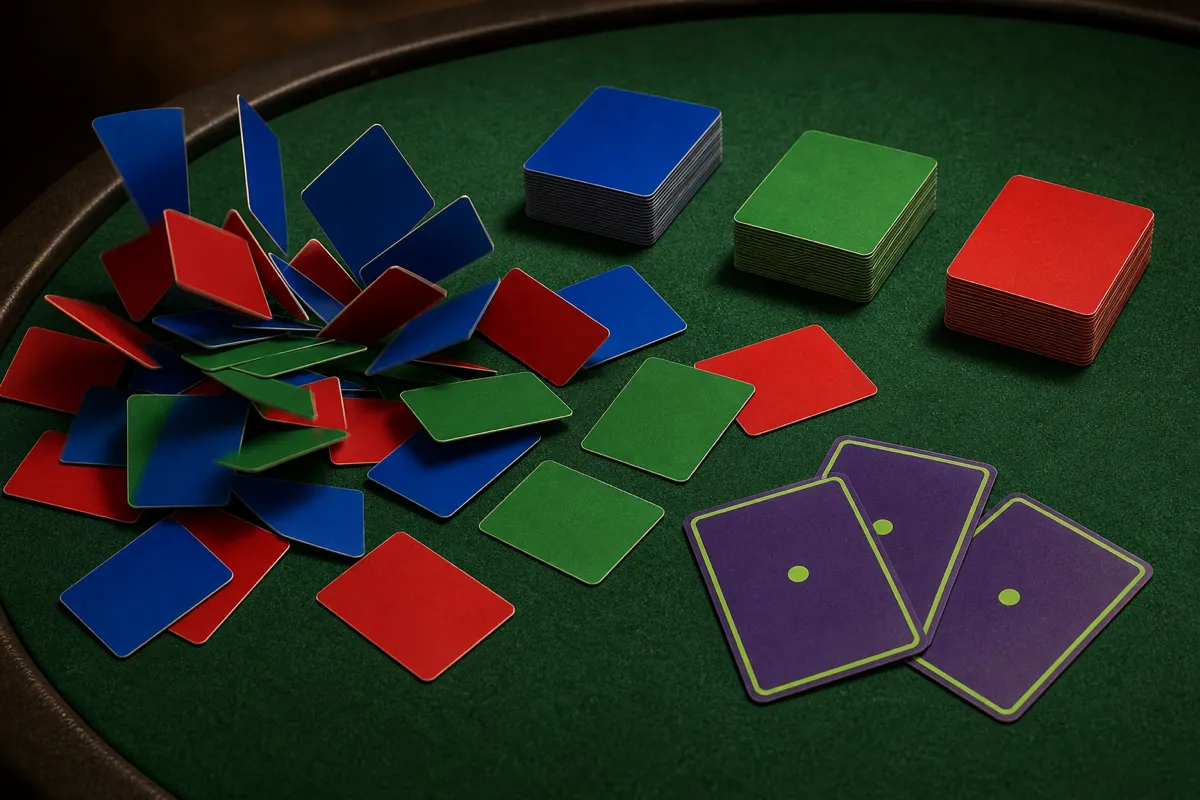
This is Skip Card with a twist: twenty power cards are shuffled into the deck. Skip makes the next player miss a turn, Bomb blows a tower back to nothing, Steal takes a card off an opponent's shelf, Rewind knocks a tower down a step and Peek lets you see what is coming in your stack. The race to empty your stack is the same as in the classic game, but no lead is ever safe.
What is different from the classic game
Everything you know from the classic game still holds: you build four shared towers from 1 to 12, play from your hand, your stack and your shelves, and end every turn by putting a card on a shelf. The first player to empty their stack wins.
The difference is in the deck. A few number cards are swapped out for twenty power cards, four of each kind. Power cards never go on a tower and never sit in a stack. Instead they do something to the table the moment you play them, and then they are gone until the deck is reshuffled.
The deck
| Card | How many | Effect |
|---|---|---|
| Number cards 1 to 12 | 9 of each, 108 in all | Build the towers |
| Wild | 18 | Any number from 1 to 12 |
| Skip | 4 | The next player misses their next turn |
| Bomb | 4 | Clears one tower completely |
| Steal | 4 | Takes the top card of an opponent's shelf into your hand |
| Rewind | 4 | Takes the top card off one tower |
| Peek | 4 | Shows you the next three cards in your stack |
Stacks are dealt only from number cards and Wild cards, so you will never find a power card in your stack. Each player starts with 20 stack cards, or 10 or 30 if you choose a quick or long game.
When you can play a power card
- At any point during your own turn, before you put your last card on a shelf.
- From your hand or from the top of one of your shelves. A power card on a shelf is a weapon you have stored for later.
- As many as you like in the same turn.
- Only when it has a target. Bomb and Rewind need a tower with cards in it, and Steal needs an opponent's shelf with a card on it.
A power card played from your hand counts as a card played. If it was your last card, you draw five new ones just like when you empty your hand on the towers. A played power card goes to the pile of cleared cards and comes back when the deck is reshuffled.
Skip
What it does: the next player misses their next turn. With two players that means you take another turn right after this one: you draw up to five again and play on.
When it is best: when your opponent is one card away from playing their stack card, or when you have a good hand but the towers are not quite ready. A double turn often lets you set up a tower on the first turn and cash it in on the second.
With three or four players: Skip only hits the player after you. Look at who is next before you play it.
Bomb
What it does: pick a tower and clear it completely. Its cards are removed and the space is empty again, ready for a new tower from 1.
When it is best: on the tower your opponent needs. If their stack card is a 9 and a tower shows 8, a Bomb sends that tower back to the start. It is also useful for yourself: if your stack card is a 1 or a 2 and every tower is high, a Bomb can open a fresh tower for you.
Watch out: you can bomb a tower that you yourself were building on. Count the cards before you blow anything up.
Steal
What it does: take the top card of any shelf belonging to an opponent and put it in your hand. You can play it on the same turn.
When it is best: when an opponent has exactly the number you need on top of a shelf, or when they have parked a Wild or a power card there. Steal also breaks up a shelf they have built in neat falling order.
Defence: don't leave a Wild on top of a shelf when your opponent might hold a Steal.
Rewind
What it does: take the top card off one tower, so the tower goes down by one.
When it is best: when a tower has just passed the number you need. Your stack card is a 7, the tower shows 7: Rewind takes it back to 6, and your 7 goes on top. It is also a quiet way to block an opponent who needs the next number on a tower.
Peek
What it does: you see the next three cards under the top of your own stack. The view stays open until your turn ends.
When it is best: before you decide which tower to build up. If you know that a 5, a 6 and a 2 are coming after your current stack card, you can build a tower so it lines up with the whole run, not just the next card.
A turn with power cards
You are playing against one computer opponent. Your stack shows 9. The towers show 3, 7, 8 and 11, and your opponent's stack shows 12, so the tower at 11 is a real danger. Your hand is 5, 6, Bomb, Rewind and a Wild.
- You play the Bomb on the tower at 11. It is cleared, and your opponent's 12 has nowhere to go.
- Your stack 9 goes on the tower at 8. A new stack card turns up: an 8.
- That 8 goes on the tower at 7. The next stack card is another 8.
- Now the towers show 3, 8, 9 and an empty space, and no tower is at 7. You play Rewind on the tower at 8, which goes back to 7, and your stack 8 goes on top. The stack turns up a 4.
- The 4 goes on the tower at 3. Then you play the 5 from your hand on it, and the next stack card, a 6, follows.
- You end the turn by putting the 6 from your hand on a shelf and keep the Wild for later.
Five stack cards in one turn, and the tower your opponent needed is gone. That is the idea of power cards: used at the right moment, one card changes the whole table.
Strategy
Hold your power cards
Power cards are strongest at the right moment, not the first possible moment. A Bomb that clears a tower nobody needs is a Bomb you don't have when your opponent is one card from winning.
Watch what your opponent can do
You can't see their hand, but you can see their shelves. A power card on top of an opponent's shelf is a threat you know about. Keep it in mind before you build a tower up to the number they want.
Store power cards on a shelf
Discarding a power card to a shelf is not a waste: you can play it from there on a later turn. It is a way to keep a Bomb ready while still filling your hand with number cards. But a power card on a shelf can be stolen.
Count the towers
Bomb and Rewind change the whole race. Before you play one, check which stack cards the change helps. Clearing a tower helps anyone holding a 1 or a Wild.
Are the power cards fair?
We tested the deck with tens of thousands of simulated games between computer players. Between two equal players, whoever starts wins about half the time. We also let only one player use a particular power card while the other had to throw it away, to see if any single card decides games on its own. None did: even then the player who could use the card won less than 60 percent of the games. The Skip card was the strongest, which is why the deck has four of them, not five.
The three computer opponents use power cards differently. Rookie plays them more or less at random. Sharp uses them when they free its stack card. Ruthless saves them for the moment they hurt you most. In our tests Ruthless beats Sharp in more than 60 percent of games, and Sharp beats Rookie in more than 90 percent.
Winning and points
The first player to play the last card from their stack wins. The winner scores 10 points plus 2 points for every card left in the other players' stacks, so a big win counts for more. If the game locks up completely (the deck is gone and nobody can change a tower any more), the player with the fewest stack cards wins.
Questions and answers
Can I play a power card from my stack?
No. Power cards are never dealt into a stack, so the question never comes up.
Can I bomb an empty tower?
No. Bomb and Rewind need a tower with at least one card in it.
What happens to a stolen card?
It goes into your hand, and you can play it on the same turn: to a tower, as a power card if you stole one, or to a shelf to end your turn.
Does Skip work with three players?
Yes. It always hits the next player in turn order. The player after them plays as normal.
Can I play two power cards in one turn?
Yes, as many as you have and can use.
Where can I play without power cards?
The classic Skip Card on the front page uses only numbers and Wild cards. If you want even more mayhem, try Chaos, which adds a table event every fourth round, or climb the Ladder.